Netflix & Warner Bros. - Hollywood's Biggest Red Flag
- DeShawn Hill

- Dec 8, 2025
- 3 min read
This is 'The Film Police' speaking—boisterous, informed, and absolutely done with watching the industry flirt with disaster.
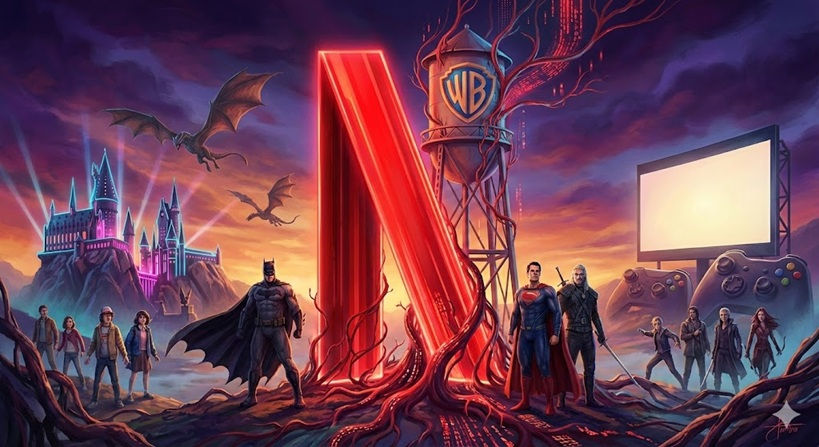
And nothing screams “disaster” louder than the whispers, rumors, and fever-dream speculation about Netflix potentially acquiring Warner Bros. You’d think Hollywood
would’ve learned its lesson by now about megamergers and corporate content mills, but here we are again, bracing ourselves for a scenario that could bulldoze decades of artistry in favor of algorithm-friendly chaos.
Let’s not mince words: Netflix has changed entertainment forever, but not always in ways worth celebrating. Sure, they gave us convenient binge sessions and a few undeniably great originals, but for every standout, there’s a wasteland of half-baked ideas pumped out at warp speed. The platform has become infamous for its uneven track record—projects that feel rushed, scripts that read like ChatGPT’s older and less capable cousin wrote them, and a critical success rate that oscillates wildly.
Netflix loves quantity, but quality? That’s always the question.
And from where 'The Film Police' sit, the answer is usually, “We’ll get back to you on that.”
Now picture that approach applied to Warner Bros., a studio with cinematic DNA pulsing through its entire history. This is the house that built Hollywood mythmaking. The lineage here spans from Casablanca and A Streetcar Named Desire to The Dark Knight, Mad Max: Fury Road, and Dune. Warner Bros. has taken risks.
It’s backed visionaries. It’s nurtured worlds that reshaped the medium.
This studio is not built for content churn; it’s built for legacy.
And then there’s HBO, Warner Bros.’ premium storytelling engine—the network that practically patented prestige television. HBO is the reason your friends rave about character arcs like they’re discussing philosophy. HBO is the birthplace of modern TV classics: The Sopranos, The Wire, Six Feet Under, Succession, Barry, Game of Thrones (well, most of it). These weren’t shows built for background noise. They were crafted. Meticulous. Dangerous. Ambitious. They’re proof that audiences crave challenge, not just comfort food.
Now imagine HBO under an algorithm.
Now imagine Warner Bros. storytelling under “content strategy.”
Now imagine cinema’s most daring voices filtered through, “Well, the data shows viewers click away after seven minutes unless someone gets pushed off a cliff.”
We at 'The Film Police' cringe just thinking about it.
Netflix’s color-by-numbers approach to filmmaking has already left the industry littered with glossy productions that somehow feel hollow, like movie-shaped objects rather than movies. When a company relies on data rather than daring, you get stories that are safe, predictable, engineered to be “consumable.” Warner Bros. is a studio built on the opposite instinct. HBO thrives because it trusts creators, not metrics.
Combining these cultures isn’t a merger—it’s a collision.
And let’s talk about Netflix’s long-standing beef with theaters. This isn’t a company that sees the big screen as sacred. It sees it as optional, inconvenient, maybe even antiquated. Meanwhile, Warner Bros. has spent a century building monuments meant to be projected fifty feet tall. Cinema is part of its soul.
Netflix acquiring Warner Bros. would be like putting a vegan in charge of a steakhouse: the foundation remains, but the spirit gets stripped out.
Or, more simply put, Netflix acquiring Warner Bros. would be like the internet sensation 'Grumpy Cat' becoming Leonardo Da' Vinci's supervisor in charge of 'quality control'... and no one wants that.
Except for, maybe Grumpy Cat.
Plus, theaters are already fighting for survival. A Netflix-controlled Warner Bros. could be the final blow, accelerating the shift toward home screens and shrinking theatrical windows until going to the movies becomes a niche hobby instead of a cultural heartbeat.
And that, dear filmmakers and film lovers, is a future that 'The Film Police' can not stand for.
We’re fed up, not because we don't appreciate change, or growth, but because we know what’s at stake.
We’re upbeat because we believe audiences are smarter than studios give them credit for. We’re aggressive because someone has to be. Fans don’t want another conveyor-belt studio. Artists don’t want another data-driven overlord. The industry doesn’t need more homogenization masquerading as innovation.
If this hypothetical merger ever became reality, 'The Film Police' would be the first to blow the whistle, the first to sound the alarm, and the first to rally the public.
Because Warner Bros. deserves better, and HBO deserves protection.
And the future of cinema deserves more than an algorithm dictating what “works.”
The film industry has survived world wars, streaming wars, studio implosions, format revolutions, and enough corporate nonsense to fill a trilogy.
It’ll survive this era too... Especially if we stay loud, stay critical, and stay passionate about real and true storytelling.
We are 'The Film Police' and as long as we are on duty, we will never stop defending the art of cinema from the forces trying to flatten it into mere 'content'.