
Jake Paul vs. Anthony Joshua: A Sign of the Times
- DeShawn Hill

- Dec 22, 2025
- 4 min read
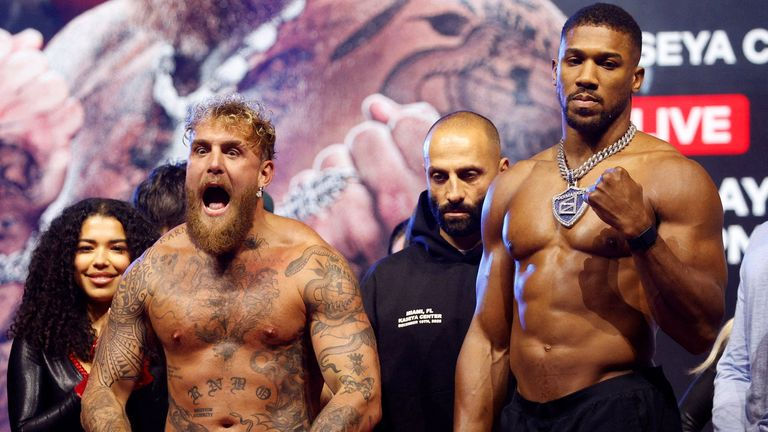
Okay, we’re going to say the quiet part out loud, badge flashing, siren on: The much-talked-about Jake Paul vs. Anthony Joshua spectacle—packaged, teased, and paraded as if it were the Second Coming of Combat Sports—was the purest expression yet of modern streaming entertainment’s favorite trick. Loud trailer. Louder marketing.
Then the bell rings and—whoops—there’s nothing there but air, algorithms, and a crowd realizing they’ve been sold the idea of excitement rather than the thing itself.
This wasn’t a fight so much as a content event. And that distinction matters. Real fights have stakes you can smell from the cheap seats. This had metrics.
It had thumbnails. It had social media countdown clocks and amped up commentary insisting history was being made. What it didn’t have, was tension that survived first the first few punches thrown. The entertainment value flatlined early, not because audiences don’t understand spectacle, but because they understand when spectacle is hollow.
Jake Paul has made a career out of gaming attention economics, and Anthony Joshua is a legitimate athlete whose presence alone can sell seriousness. On paper, the contrast looks combustible. In practice, it looked like one-sided after-school scuffle that the principle would be forced to break up.
Netflix, of course, sold this as a win for the future. Big names. Global reach. Everyone talking. But being talked about is not the same thing as being enjoyed, or valuable, and 'The Film Police' are here to remind you that replay value is always the real currency.
No one with full command of their brain cells is rewatching this thing the way they would rewatch classic fights, iconic sports moments, or genuinely electric live events.
This 'mega-fight' evaporated the second it ended, like the cheapest value deal from Taco Bell.

This is the danger zone Netflix is sprinting toward, arms wide open, ticker tape already falling.
The Jake Paul–Joshua affair wasn’t an anomaly; it was a mission statement. Market first, substance later, and hope the audience is too busy scrolling to notice the gap. When the platform prioritizes “moments” over meaning, you get entertainment that looks phenomenal in a trailer and collapses under the weight of its own hype.
We’ve seen this movie before, just not always in a boxing ring.
Remember the blockbuster originals that launched with Super Bowl-level promotion and vanished from the cultural conversation within a week? Remember the prestige projects that arrived with Oscar whispers and left with a shrug? The formula is consistent: inflate the promise, flatten the experience. The Jake Paul vs. Anthony Joshua fight just made the strategy impossible to ignore because it unfolded live, in real time, with nowhere to hide.
Now zoom out, because this is where the sirens get louder. With industry chatter swirling about Netflix’s near-inevitable acquisition of Paramount—or at least the absorption of its DNA, assets, and franchises—the implications are stark. Paramount is a studio built on legacy. On craft. On decades of understanding that entertainment works when the audience feels respected rather than managed. Drop that library into a system optimized for churn and hype cycles, and you don’t get a renaissance.
You get content cosplaying as art. Insignificant drops in a bucket cosplaying as powerful waves of entertainment.
Imagine the future as it’s being quietly sketched out. Classic franchises revived not because there’s something urgent to say, but because the algorithm spotted nostalgic engagement spikes in the Midwest. Iconic characters introduced with thunderous marketing campaigns, only to be flattened into eight episodes of algorithm-approved beige. Theatrical instincts replaced by "white-noise" storytelling that never demands your full attention because it was never designed to earn it.

The Jake Paul–Joshua fight is the prototype. A headline engineered to dominate feeds. A production designed to look expensive rather than feel essential. A viewing experience that mistakes volume for impact.
If this is how Netflix handles an event with real-world stakes and living, breathing participants, imagine what happens when they fully inherit a century’s worth of intellectual property.
The danger isn’t that they’ll ruin it loudly. It’s that they’ll drain it quietly, wrapping dilution in glossy key art and calling it innovation.
And don’t get it twisted... we are not anti-commercial.
'The Film Police' love a well-oiled hype machine when it delivers the goods. We love spectacle when spectacle knows what it is. The problem is not selling; it’s overselling. The problem is promising an era-defining experience and delivering something that feels like a content obligation checked off on a quarterly report.
Stark comparison time. When a great live event ends, people argue about it for years. They relive it. They quote it. When this fight ended, the conversation immediately shifted to memes about the marketing. That’s the tell. When the campaign becomes more memorable than the content, the content has failed.
Netflix’s future doesn’t have to look like this, but the warning signs are neon-bright.
If the platform continues to conflate attention with affection, and buzz with value, audiences will keep showing up out of habit and leaving unsatisfied.
That’s not loyalty; that’s Stockholm Syndrome.
The Jake Paul vs. Anthony Joshua spectacle wasn’t just lackluster entertainment. It was a case study. A glimpse into a potential era where everything is an event and nothing is an experience. Where legacy brands are mined for clicks, not care. Where “big” replaces “good” as the primary metric of success.
With that being said, 'The Film Police' have issued the citation... The crowd has felt the obvious and inevitable letdown and now the only question is whether Netflix reads the room—or just the data.
Because if this is the future of well-marketed disappointment, the badge is staying out, and the siren is only getting louder.


